Emergency Medical Services program upgrades lab space with $400,000 grant
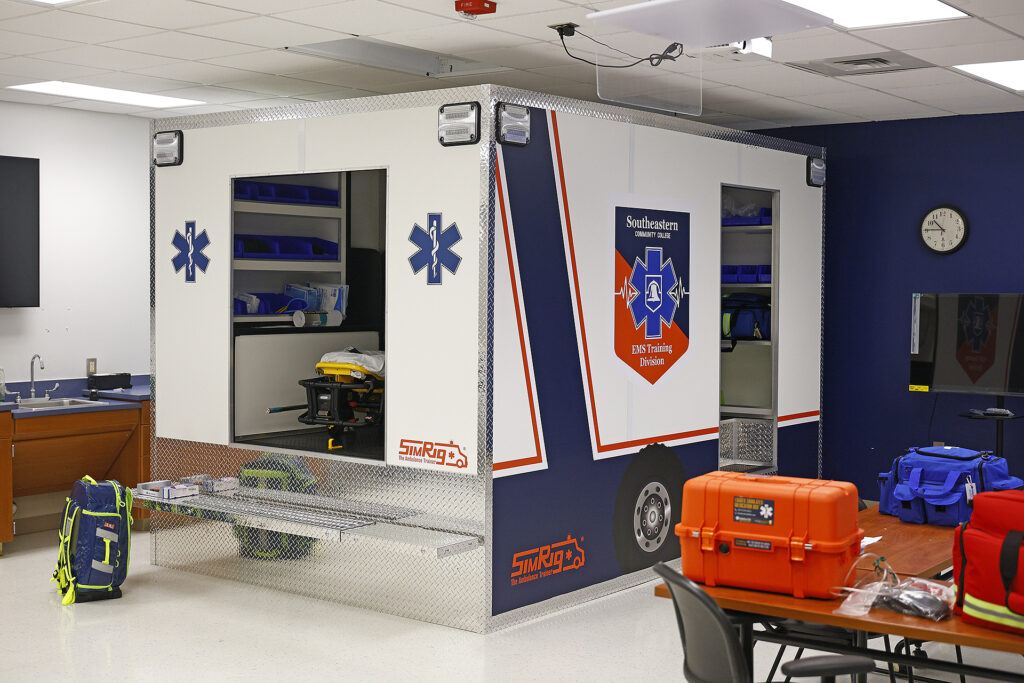
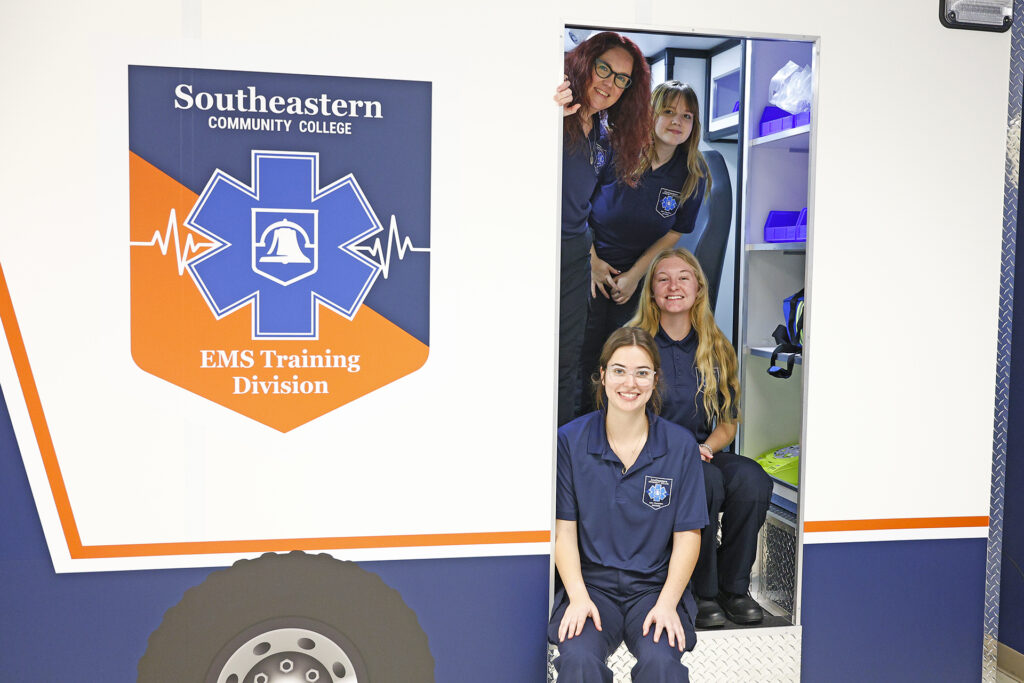
With the help of a NC Community College System High-Cost Healthcare Workforce Program Grant worth $400,000 awarded earlier this year, Southeastern Community College’s EMS lab room landed a major upgrade in equipment and cosmetics. This upgrade, which included an ambulance truck simulator, will give EMS students “the most life-like experience in class,” said Alex Barnhill Lee, EMS Instructor/Clinical Coordinator.
“The installation of a simulation rig ambulance inside the EMS lab is a significant step forward in hands-on, immersive education for our students,” said Stephen Hester, EMS Program Coordinator. “Bringing a realistic emergency response setting into the classroom allows learners to connect theory with practice in a controlled, supportive environment.”
The ambulance truck simulator is equipped with lights, a siren, a suction unit, a stretcher, a cardiac monitor, high-fidelity mannequins and all medical instruments found on an ambulance. Along with the simulator, the lab’s walls were painted, new tables were installed, new IV mannequin arms were purchased and a new LUCAS device for CPR was purchased.
“It’s as real as we’re going to get in the classroom setting,” Barnhill said. “With the high-fidelity mannequins, you can check blood pressure and pulse. Instructors can change those numbers, and the students have to figure out why.”
Hester explained that the ambulance simulator lets students experience the complete patient-care process, from dispatch to arrival on scene, to transport preparation, mirroring the critical thinking, communication and technical skills needed in real EMS operations.
“This hands-on setting ensures they learn skills and get EMS experience before ever stepping into an actual ambulance,” Hester said. “The simulation rig lets students practice equipment placement, stretcher handling, airway management, medication administration and patient movement within the same space and environment they will encounter in the field.”
In addition to being the EMS lab, the room is also equipped and designated as a high-flex classroom with the ability to video and audio record instructor lectures. The ambulance simulator cameras can record student-performed scenarios and be rewatched for teachable moments later on.
Lee explained that along with the upgraded EMS lab, the grant provided funding for an associates degree in EMS, a first for SCC, and the opportunity to bring back its curriculum paramedic class, which has not been taught since 2022. Curriculum students and continuing education students work together in Lee’s EMS classes. By this time next year, the EMS program will feature classes in EMT, Advanced EMT, Paramedic and Field Training Officer.
“I’m excited for these students to use this new lab, and the students are too,” Lee said. “The North Carolina Community College System representative came in and checked off on all requirements, so it’s good to go for use.”
Hester said that adding the ambulance simulator to the lab aligns with national best practices in EMS training and simulation learning. It supports competency-based education by enabling students to repeatedly practice scenarios and receive immediate feedback, two proven methods for enhancing clinical performance and retention.
“This immersive experience nurtures professionalism and emotional readiness,” Hester said. “Students will learn to stay calm in chaotic environments, think critically during time-sensitive situations and collaborate effectively as part of a team, qualities that separate competent providers from exceptional ones.”
For SCC, the simulation rig ambulance is more than just equipment; it is a valuable educational investment that boosts student learning, enhances workforce readiness and reinforces the college’s mission to develop skilled, confident and compassionate EMS professionals. By providing this experiential learning level, SCC is meeting educational standards and setting students up to exceed them, Hester said.
“The January cohort will enter clinicals and field internships more prepared than ever, ultimately graduating as highly capable, confident and compassionate EMS professionals ready to serve their communities excellently,” Hester said.
Interested in a life-saving career in EMS? Spring semester registration is now open. Call 910-788-6247 today to learn more about class options and get on the path to saving lives!