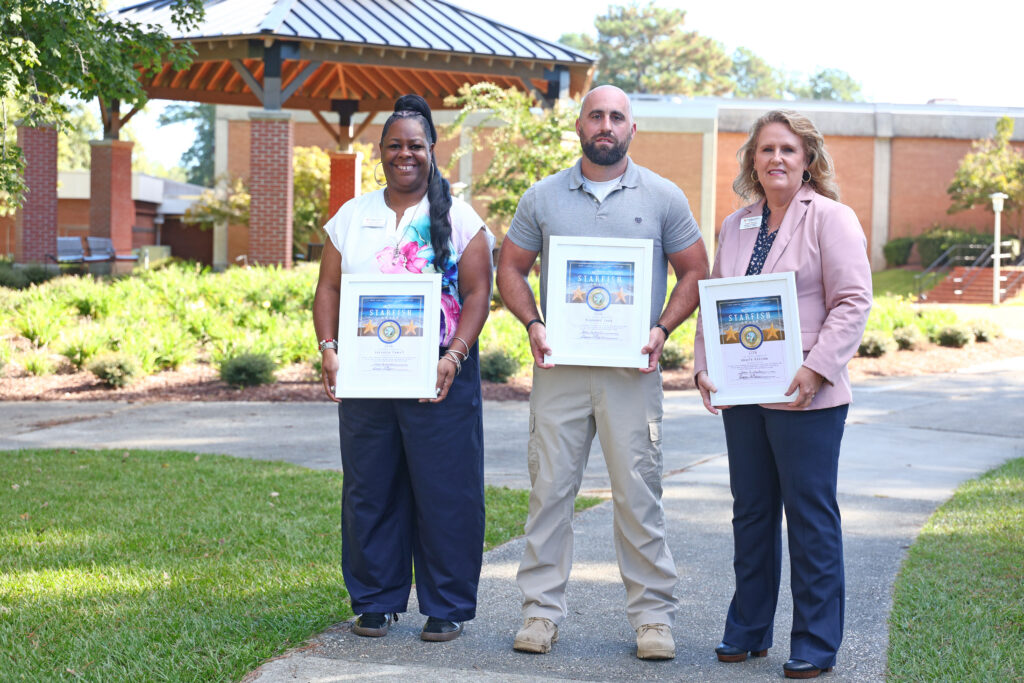
SCC’s Prison Education program earns Starfish Award
Southeastern Community College’s Prison Education programs recently received the Starfish Award from the N.C. Department of Adult Correction’s Education Services division in recognition of the college’s efforts to expand educational opportunities for students at Tabor Correctional Institution and Columbus Correctional Institution.
The award was presented during the N.C. Department of Adult Correction Educational Symposium held Oct. 6 at Cape Fear Community College. SCC representatives who accepted the award included Dr. Veronica Powell, associate dean of Transitional Studies and Prison Education; Raymond Long, prison education coordinator; and Angela Ransom, associate vice president.
The Starfish Award is presented annually to correctional education staff and community college partners who make a positive impact on educational programs within the Department of Adult Correction. The award takes its name from “The Starfish Story” by Loren Eiseley, a parable that emphasizes the importance of helping individuals one at a time and recognizing that even small actions can make a meaningful difference.
According to Jana Demetral, South Central Regional Education Coordinator with the Department of Adult Correction’s Education Services division, SCC was selected because of its commitment to expanding educational opportunities at both correctional facilities.
“We chose Southeastern staff because of their dedication, commitment and help in growing our programs not only at Tabor CI, but Columbus CI as well,” Demetral said. “We have new programs in Automotive at Tabor and the associate degree program in Audio and Video Production Technology at Columbus CI.”
The partnership between SCC and the Department of Adult Correction has expanded educational pathways through high school equivalency instruction, workforce training and college-level coursework. Programs currently offered include High School Equivalency preparation, Audio and Video Production Technology, Automotive Systems Technology, Human Resources Development, Office Practices, Advanced Office Practices and Commercial Cleaning.
Demetral explained that the collaboration has created new opportunities for students while preparing them for employment after release. She noted that SCC and its correctional partners launched the state’s first prison podcast through the Audio and Video Production Technology program and are working to expand the Automotive Systems Technology program into an apprenticeship pathway that could lead to work-release employment opportunities.
“Our partnership with Southeastern is providing the necessary education and needed skills for offenders to have a successful reentry in the workforce,” Demetral said.
Powell said SCC’s approach to prison education centers on providing incarcerated students with the same educational opportunities available to students throughout the college.
“We are trying to make a difference in the prisons and NCDAC recognizes our hard work and dedication,” Powell said. “We are marking new territory. The programs that we are implementing in these facilities have never been done before.”
Powell explained that SCC views incarcerated individuals as students and works to remove barriers that may affect their ability to succeed.
“Dr. English has said numerous times that ‘a student is a student is a student,'” Powell said. “And we take that statement to heart. We see the incarcerated population in our county facilities as students. We try to provide high-quality learning while eliminating as many barriers as we can.”
Although she was surprised by the recognition, Powell said the award reflects the work SCC faculty and staff do every day.
“On one hand, I was pleasantly shocked when we were recognized,” Powell said. “On the other hand, I felt like we work hard for all our students. We try to make sure every student has an opportunity to learn, even those behind the walls. We were just doing what we love to do. We are honored to be recognized for that love.”
Long said the award recognized the dedication of SCC instructors and staff who continue to expand educational opportunities within the correctional system.
“I believe SCC’s Prison Education program was selected because of the dedication, creativity and hard work of our instructors and staff,” Long said. “We have a great team of educators who genuinely care about student success. Our program goes beyond traditional classroom instruction by providing students with practical skills, confidence and opportunities they can use after incarceration.”
Long said he felt proud of the entire team when SCC received the award.
“I was excited and proud of our entire team,” Long said. “Teaching in a correctional environment comes with unique challenges, but our instructors consistently find ways to overcome them and help students succeed. It’s rewarding to see everyone’s hard work recognized.”
Long highlighted the contributions of instructors across the program, including those teaching High School Equivalency classes, Human Resources Development, Office Practices, Advanced Office Practices, Commercial Cleaning, Automotive Systems Technology and Audio and Video Production Technology.
“Each of these instructors brings something valuable to our program, and I’m proud of the work they do every day,” Long said.
Long said prison education gives individuals an opportunity to develop skills that can lead to successful employment after release.
“Finding employment after incarceration can be difficult, and our goal is to help students develop the skills and confidence needed to succeed,” Long said. “Whether it’s earning a high school equivalency diploma, learning a trade, becoming proficient with technology, or exploring entrepreneurship, these opportunities can help students find employment, support their families and become productive members of their communities.”
Dr. Brandon Jenkins, SCC executive vice president and chief academic officer, said the expansion of prison education programs required a strong partnership between the college and correctional facilities.
“Getting these programs off the ground has been a true labor of love,” Jenkins said. “There are so many nuances to prison education. Standing up new programs never happens overnight. It takes a truly collaborative effort between our team here at SCC and our prison partners.”
Jenkins explained that the award reflects the work completed by SCC employees and the partnerships established with Tabor Correctional Institution and Columbus Correctional Institution.
“To be recognized by the Department of Adult Corrections for the Starfish Award is a reflection of the countless hours of hard work put in by our team and the strength of our partnership with both Tabor Correctional and Columbus Correctional,” Jenkins said.
Jenkins said SCC’s prison education efforts are especially important because Columbus County is home to two correctional facilities.
“With Columbus County being the home to two prisons, there is a significant opportunity to reach a lot of men who may not have a high school diploma or workforce skill,” Jenkins said. “Offenders who leave the prison setting with either their high school equivalent or a workforce skill are more likely to have successful reentry into the community upon their release.”
Ransom said SCC has made prison education a priority and has continued expanding educational opportunities that align with the goals of correctional leaders and state education officials.
“We’re really honored to receive that award,” Ransom said. “We really prioritized our Prison Education program since December when Veronica’s new associate dean position was created.”
Ransom explained that SCC has focused on strengthening its existing programs while creating new opportunities for incarcerated students.
“We have focused efforts on improving everything that we do at the prisons,” Ransom said. “We are expanding everything that aligns with the vision of the wardens and our regional education specialist.”
Ransom said the availability of day and evening classes, the launch of the state’s first curriculum-based Audio and Video Production Technology program in a correctional facility and the expansion of digital literacy and workforce training opportunities contributed to SCC receiving the award.
She said the recently established Automotive Systems Technology program and digital literacy courses provide students with skills that can improve employment opportunities after release.
Ransom explained that receiving the Starfish Award came as a surprise because SCC representatives attended the symposium without expecting to receive the honor.
“I was shocked and pleasantly surprised,” Ransom said. “It was quite an honor to be nominated by Jana because she has been with us every step of the way.”
Ransom said the partnership between SCC and the Department of Adult Correction’s Education Services division has been strengthened through regular communication and a shared commitment to supporting students and instructors.
“From our monthly meetings to even speaking with her two to three times per week to focus on the work, it’s been truly amazing to partner with her on behalf of the students and instructors in making sure that we’re advocating for all the things that are necessary for learning to progress,” Ransom said.
Looking ahead, SCC plans to continue expanding educational pathways that align with workforce needs, support digital literacy and create opportunities for students to earn credentials, diplomas and degrees while incarcerated.
“If we were able to change just one student’s life while they served time in prison, we know this work has all been worth it,” Ransom said. “We know that education has the potential to make a difference in everyone’s life, and we’re thankful to be involved in this work.”