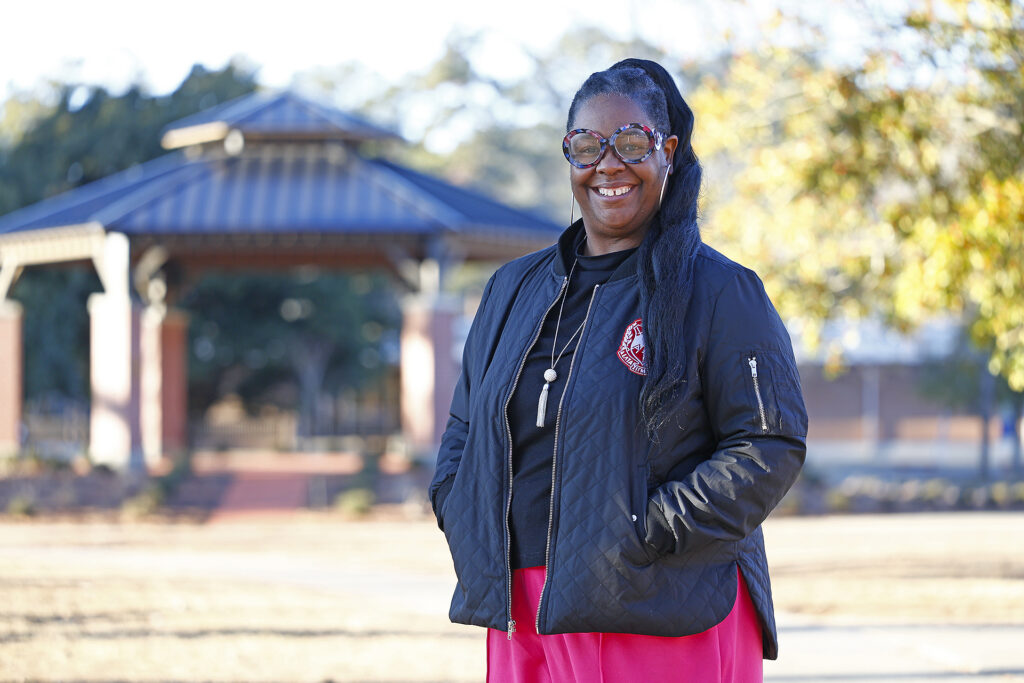
Veronica Powell appointed Associate Dean of Transitional Studies and Prison Education at SCC
Veronica Powell, a Lumberton native, was promoted from Director of Transitional Studies to Associate Dean of Transitional Studies and Prison Education at Southeastern Community College. Starting her new role on Jan. 5, Powell is tasked with building a stronger relationship with Columbus County’s two prisons: Tabor Correctional Institution and Columbus Correctional Institution. Her goal is to create and maintain new classes taught at the prisons, grow the current high school equivalency diploma program at SCC and the prisons and knock down barriers to student success.
“This allows us to dedicate a leader with a more defined purpose and focus on Prison Education, and it allows us to be more responsive to expansion in the prisons,” said Angie Ransom, Associate Vice President of Education and Training. “We’re helping to address those prison education and re-entry initiatives set forth by Gov. Stein.”
Ransom described Powell as a “really good listener, thinker and problem solver” who understands the importance of Prison Education at SCC. Ransom recognized Powell’s value of relationships, her interpersonal skills and her heart for the prison population in Columbus County.
Prison Education
Because of Powell’s already established presence in the prisons with Transitional Studies, Powell said this new title for her “just makes sense.” Expansion and improved relationships are her main goals, and Powell wants to see more short-term and associate degree programs offered at the prisons.
“I’m excited about the Prison Education program because I can give it the attention it deserves,” Powell said. “It’s a win-win situation when we can offer classes at the prisons, the offenders get time off their sentences and the college gets a boost in enrollment.”
Powell will oversee the first associates degree program created for Columbus Correctional Institution: Audio and Video Production Technology. She described this program as an “amazing opportunity” for offenders who already have their high school equivalency diploma or high school diploma who want to continue further.
“We’re excited about these opportunities for offenders because it’s sad if they have to stop at a certain level,” Powell said. “We can empower them to go further.”
With expanded options in construction, automotive, truck driver training and electrical engineering on the horizon, Powell said the end goal of Prison Education is to make offenders job-ready upon re-entry into society. She is looking to place simulation equipment at the prisons for offenders to train on.
Having a goal to work towards while in prison, offenders can earn a diploma or associates degree under Powell’s watch. She said this educational goal makes her job fulfilling in knowing that she is helping offenders return to their families at a faster rate and with marketable skills.
Transitional Studies
As an Educational Leadership doctoral candidate working to defend her dissertation soon, Powell is discovering and researching barriers High School Equivalency Test (HiSET) students face when trying to obtain advanced degrees. She wants to know why students are stopping their educational journey at a high school equivalency diploma and not going further.
“For people outside those prison walls, I found that barriers such as transportation, childcare, unawareness of the enrollment process and financial aid are the main culprits,” Powell said. “For people inside those prison walls, the barrier they face is that the class option isn’t there. But now, I can fix that real fast and offer those classes they need.”
Powell explained that high school equivalency students need extra support “cheerleaders” like Cheri Barkley, a basic skills plus career coach, to keep students on top of their classwork and testing days. She said that if she can knock down a transportation or childcare barrier that keeps students from showing up to campus, she will apply for every financial assistance voucher available.
“While working on my dissertation, it has sparked my creative mind, and I want to keep knocking down walls for the students,” Powell said. “Thanks to the SCC Foundation’s Mini Grant program, I was able to purchase more vouchers to help pay for students to take the HiSET exam. With each part of the exam costing $15 each, that may not seem like a lot to us, but that can make or break some of my students.”
Making barrier and success recognition a team effort, Powell has regular meetings with her staff to discuss the barriers to completion and their students’ successes in the program. Powell said that social media encouragement and motivation from the community will spark a student’s drive to continue. Each time a student passes their HiSET, their photo is taken while holding a sign that reads “I’m a HiSET graduate.” Powell said those photos have accumulated reactions and shares on social media that later go on to encourage other students to continue or start the process.
As Powell continues to research, apply for financial assistance programs and keep close relationships with her students, she envisions growth in enrollment for her program. Her team is working to provide digital literacy for students in online classes, bus and gas vouchers for transportation to campus and solutions to childcare needs. Because of her efforts in breaking barriers, Powell said the Transitional Studies program has seen the largest growth in graduation rates since 2019.
Interested in earning your high school equivalency diploma at SCC? Contact Student Services at 910-788-6279 or visit A-building on campus to connect with a student advisor.