Wood leads new Pathway to Employment initiative; has eyes on state-wide implementation
Leading the way on the Pathway to Employment (PTE) Alignment Project, Southeastern Community College’s Cristian Wood will direct a cohort of 14 community colleges within the North Carolina Community College System. As the host college for the project, SCC’s own success with PTE courses will be a model for other colleges to follow.
“I have truly valued my work with Pathway to Employment as the Pathway to Employment Coordinator here at SCC,” Wood said. “This role has been both meaningful and energizing, and I am genuinely excited for the opportunity to collaborate with a diverse group of subject matter experts from community colleges across the state. Together, we can strengthen PTE courses and create an even more impactful launchpad for learner success.”
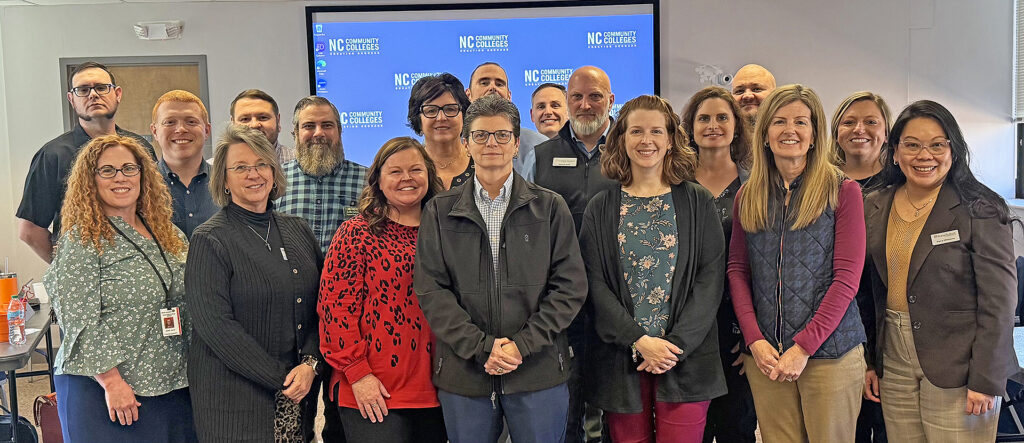
Joining SCC on this project are Central Piedmont, Wilkes, Rockingham, Forsyth Tech, Wake Technical, Randolph, Asheville-Buncombe Technical, Craven, Bladen, Roanoke-Chowan, Vance Granville, Mayland and Brunswick Community colleges in addition to Caldwell Community College and Technical Institute. Wood met with representatives from these colleges on Feb. 10 in Raleigh to discuss a plan of action.
“The PTE Alignment Project will revise, enhance and deliver a full set of twelve Pathway to Employment courses to ensure statewide alignment with the North Carolina Career and College Ready Pathway (CRP) dual-enrollment framework,” Wood said. “This initiative builds a scalable, cohesive instructional pathway that strengthens connections between secondary education, community colleges and workforce sectors across the state.”
Expected outcomes for the project, Wood said, will include updated PTE curriculum aligned with CRP pathway standards, fully developed PD modules/resources for new instructors, a replicable statewide framework for implementing pre-apprenticeship opportunities, and increased instructional consistency and workforce alignment across the 58 community colleges. She anticipates adoption of this plan at more than 20 colleges during the 2026–27 academic year.
“In our PTE courses at SCC, students can explore career fields within their major and verify that they are in the correct program,” Wood said. “PTE courses offer job shadow opportunities, discussions with industry partners and industry partner work site visits.”
Ashley Parrott, State Director of Developmental Education and College Readiness, said her two sons found success in PTE courses while in high school. They confirmed that engineering was their career path because they could “dip their toes in the water,” she said. Along with exposure and excitement, Parrott said her sons got a “slice of the real world” while taking PTE courses. She explained that PTE courses combine the best of the workforce experience and college life to make students their “best selves.”
“So, for those that do or don’t know what they want to do, they can get a more robust, kinesthetic style experience in specific career fields,” said Aaron Mabe, State Director of Dual Enrollment. “I didn’t know what I wanted to do when I was 16 or 17 years old. So, I think it’s far better for us to provide the experience for students to say this is all the things you can do in healthcare. You don’t have to just be a nurse, for example.”
Mabe explained that giving students an experience and arming them with information so they can make an informed decision about their career path are the goals of PTE. He hopes the PTE Alignment Project will “open the floodgates” to make real local impacts on the workforce. He envisions industry partners “getting on board” with the project in offering or expanding apprenticeship opportunities for students.
“This Pathway to Employment Alignment Project turns this initiative into a springboard and launches it into the future,” English said. “For the next two years, SCC’s business administration instructor, Cristian Wood, will be the leader on this project because she really understands those soft skills and employability skills needed to be productive in the marketplace.”
In addition to cultivating soft skills, English said that career exploration was a key component to Pathway to Employment. While in a PTE course, students learn about their career interests and can decide what they like or dislike before enrolling in classes towards a specific degree or certificate program.
By May 2027, English envisions the Pathway to Employment Alignment Project taking PTE classes “to the next level.” With the goal of scaling this initiative statewide to all 58 community colleges, English hopes that PTE will become a curriculum standard.
The idea for PTE courses started almost 10 years ago, English said, when soft skill training modules were introduced to college classes at Nash Community College. English explained that the modules did not have a successful response with a lack of understanding on how to effectively implement the soft skills in the courses.
When he and former colleague Frank Scalleti combined research and course creation skills, they formed specific points of interest from employers. Employers wanted their job applicants to show up on time, dress for success, have effective communication skills and have an updated resume. English said that job shadowing and interning were the best ways for students to experience a “day in the life” of an employee.
“And so, we named it Pathway to Employment, and it has been very successful in its implementation here at Southeastern Community College,” English said. “Unfortunately, when it launched in 2020, we had the pandemic. It wasn’t until 2022 that we were able to gather feedback from students and employers on how it was working.”
In 2026, Pathway to Employment courses at SCC are leading the way for students into jobs, internships and apprenticeships. With the alignment project lifted off the ground, Wood aims for state-wide implementation at all 58 N.C. community colleges.